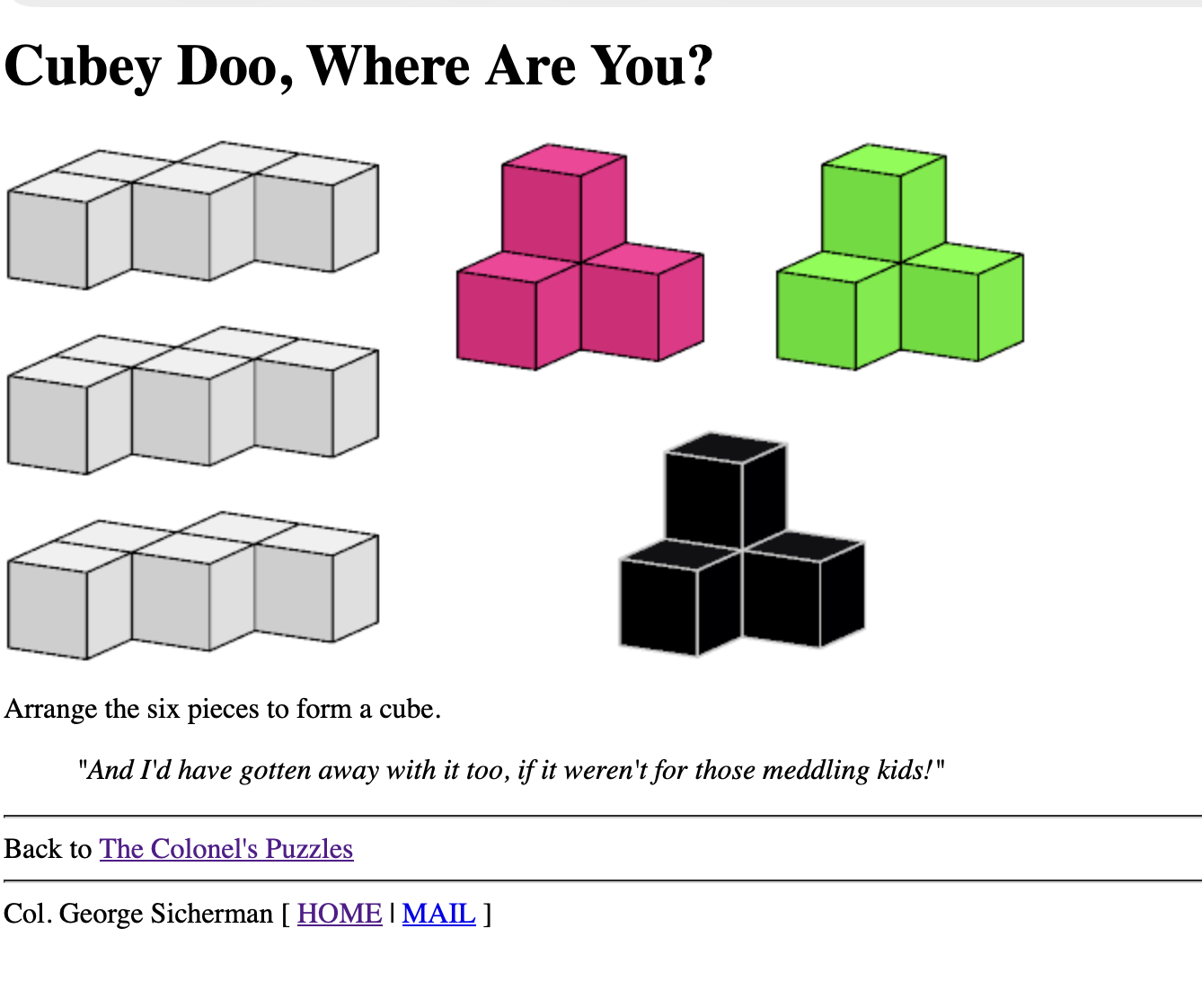
Something simple was needed to keep me busy today, so a cubic dissection puzzle from a prolific puzzle designer, Col. George Sicherman came to mind. This puzzle he calls "Cubey Doo, Where Are You", a simple puzzle of six pieces with two shapes.
Four different species of wood were selected, cherry, walnut, oak, and maple, a sampling of hardwoods. One length of oak was already the desired 1/2" X 1/2", so the others were cut to this size. The table saw's fence was set 1/2" from the blade with this piece of oak. The other cutoffs of wood were then cut to the same dimensions, using a featherboard to keep the wood tight against the fence.
Two different lengths of these wood cutoffs were needed, 1" and 1/2". A block of purpleheart was set against the fence and two of the just cut pieces were set between the block and the blade to set the fence. Using the crosscut sled the stock was held pressed against the block, moved off of the block and cut. A similar process was used for the 1/2" long blocks. The first picture below shows this setup process, while the second shows the eighteen cut blocks.


The first set of blocks were glued together with yellow wood glue. A variety of clamps were utilized. Squeeze-out was wiped off with a wet towel, though care was taken to avoid squeeze-out on the inside corners. A technique I have found helpful is putting the glued parts together and letting them sit for a few minutes prior to clamping. This avoids most of the slipping and sliding of parts caused by the inevitable clamp misalignment.

After an hour or so the second round of glueups were undertaken. Again care was taken to avoid glue pooling in the inside corners. The photo below shows the puzzle pieces at this point.

A bit of sanding and then assembly was tested, though the Colonel didn't provide a solution for this puzzle. With so much symmetry in the pieces, I assume the solution will also display significant symmetry. Not much symmetry that I can discern in the solution, though I don't know if there is more than one way to solve this puzzle. The six pieces were coated twice with wipe-on polyurethane and the assembled puzzle is shown below. (Spoiler Alert!!)


All six faces are shown, but the change in lighting (shop vs. desk) makes distinguishing the different wood types difficult in the second photo.